By Patrick Rafferty, Owner & Executive Producer, RaffertyWeiss Media | Last updated: August 2026
The corporate video production process is a five-stage workflow: discovery and strategy, scripting and storyboarding, production, post-production, and delivery. Each stage ends in a client approval that the next stage depends on, which is why the stages run in sequence rather than in parallel. For most organizations, the full process takes four to twelve weeks from first conversation to final delivered file. Project fees typically run from $3,750 for capture-only work to $25,000 for multi-day event coverage. The three factors that move a project within that range are the number of shoot days, whether editing is included, and the number of final deliverables.
The rest of this guide covers each stage in detail, with the timelines, costs, and preparation requirements that come with it.
Why the Process Matters
I've been producing corporate video in Bethesda, Maryland and across the Washington, D.C. region since 2001. In that time the cameras have changed completely and the process has barely changed at all.
Here is the pattern I see: the projects that go badly almost never go badly because of the shoot. They go badly because nobody decided who signs off, or because the message was still being argued about the week before filming, or because someone assumed a two-minute web video and someone else assumed a training module with captions and a Spanish version. Those are all discovery problems. They are cheap to solve in week one and expensive to solve in week six.
So this guide walks through the five stages of corporate video production, from discovery and scripting through production, post-production, and delivery, with honest timelines, the real cost drivers, and the specific things I need from your team to keep a project on schedule.
Stage 1: Discovery and Strategy
Discovery decides what the video has to communicate, who it has to reach, and what "done" looks like. Every downstream decision, from crew size and shoot days to edit complexity and the number of deliverables, traces back to this conversation.
In a discovery session we settle:
- The single communication goal, and what you want the viewer to do after watching
- The audiences, and what each one already knows
- The core message, supporting points, and call to action
- Where the video will live: website, intranet, event stage, LMS, social, paid media
- The launch date, and what it's tied to
- The budget range, and what it can realistically buy
- Who has final approval. Not who reviews. Who signs.
- Locations, participants, security clearance, site access, and accessibility requirements
That approval question is the one people skip, and it's the one that costs the most. A project with three reviewers and one decision-maker moves fast. A project with three reviewers and three decision-makers stalls in post-production, because conflicting feedback has no tiebreaker. I ask for a named approver in the first meeting, every time.
Discovery also determines the storytelling format. A CEO message to employees needs a controlled interview setup and a teleprompter. A workforce training video needs demonstrations, screen graphics, and voiceover. A recruitment piece needs real employees who aren't reading a script.
Here's what that looks like in practice. For the National Mining Association, we filmed a mile underground in a working coal mine, along with surface operations across multiple locations over a multi-day shoot. Every day began with a safety meeting for the entire crew, and the schedule was built around the mine's operations rather than ours. We ran GoPros, drones, 4K cinema cameras, and still photography simultaneously, because no single camera format conveys what it actually feels like to be that far below the surface. That footage became policy videos, recruiting videos, short-form cuts for LinkedIn, Instagram, and Facebook, and a library of still images NMA continues to use in advertising campaigns, internal and external presentations, and across their digital platforms. See more of this work on our portfolio.
None of that happens without heavy pre-production. A mile underground you don't get to improvise, and you don't get to send someone back to the truck. Every setup was planned before we went down, which is exactly why we didn't burn production time on location figuring it out.
Our corporate video production services support organizations through strategy, creative development, filming, post-production, and final delivery.
How long it takes: several days to two weeks. Projects spanning multiple departments, locations, or compliance reviews need longer before scripting starts.
Stage 2: Scripting and Storyboarding
Scripting turns the strategy into the actual words and images. Depending on the format, we develop a narration script, interview questions and talking points, scene descriptions and planned coverage, motion graphics concepts, or a full storyboard.
The level of detail scales with the production. A scripted executive message needs exact wording and teleprompter formatting. A brand story built on interviews needs approved questions and a visual outline, then room for people to talk like themselves. Over-scripting an interview is the fastest way to make a real employee sound like a hostage video. Animation and technical demonstrations need the most detail, because in animation every frame is built rather than captured, and changing your mind after the storyboard is approved means rebuilding.
This is the stage where approval matters most. Once the script and visual direction are signed off, we schedule the shoot. Feedback that arrives after filming can only be fixed in the edit, and some of it can't be fixed at all. If the question wasn't asked on camera, the answer doesn't exist.
One request I make of every client team: consolidate your feedback into a single document before sending it. Five people commenting independently on the same script generates contradictions that I can't resolve on your behalf.
How long it takes: several days to two weeks, driven mostly by the number of reviewers and the length of your approval chain, not by the writing.
Stage 3: Production (The Shoot)
Production is the shoot. Crew, equipment, locations, and schedule all follow from what was approved in stages one and two.
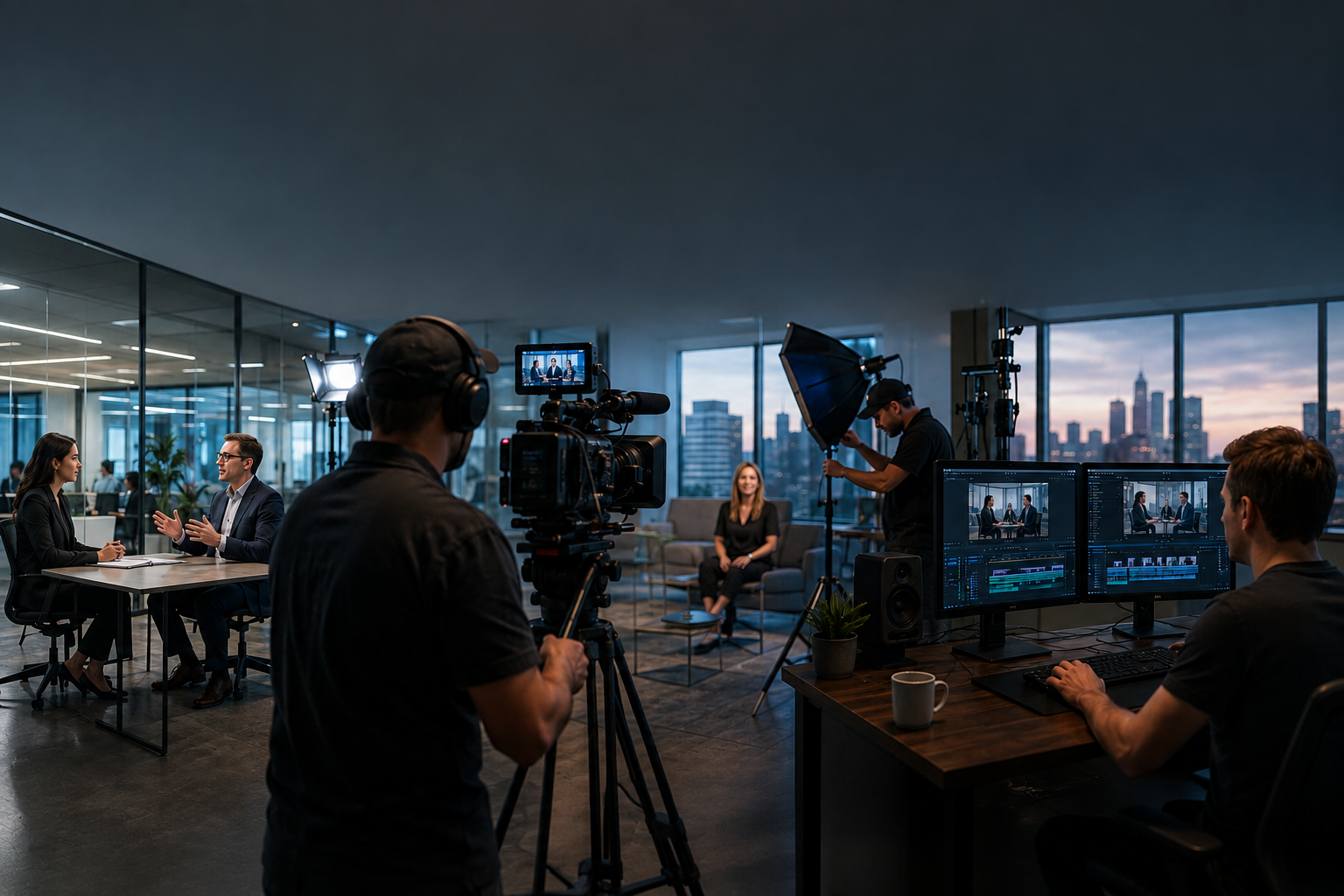
Filming happens at your offices or facility, at a conference or event, across multiple locations, in a studio, or in some combination. Depending on scope, the crew includes a producer, director, camera operators, audio technicians, lighting and grip, a teleprompter operator, and hair and makeup. On a typical corporate shoot, you'll have one point of contact from us and a written schedule for the day.
What we're usually capturing:
- Executive and subject-matter-expert interviews
- Employee, member, or customer perspectives
- Product, process, or technical demonstrations
- Facility and workplace footage
- Event and presentation coverage
- B-roll that gives the interviews something to cut to
A note on that last one: B-roll is the thing clients undervalue most and the thing editors need most. An interview with no supporting footage is a talking head for four minutes. Budget the time for it.
How long it takes: a focused interview or leadership message is one day. Multiple speakers, buildings, or cities means multiple days. The planning in stages one and two is what keeps a one-day shoot a one-day shoot.
What we need from your team
This is the section most production companies leave out, and it's the one that actually protects your schedule.
- Participants confirmed and briefed at least a week out, with the questions sent in advance
- Location access: badges, escorts, freight elevator reservations, parking, load-in times
- Permission to light and place equipment in the spaces we're filming
- Brand assets: logo files, fonts, color specs, existing style guide
- Signed releases from everyone appearing on camera
- A quiet room. HVAC, open-plan noise, and hallway traffic cause more retakes than anything else on a corporate shoot
Stage 4: Post-Production
Post-production is where the footage becomes the video. Editors review everything shot, select the strongest material, and build the structure and pacing around the approved message.
Depending on the project this includes footage review and selection, editing and narrative development, color correction, audio editing and sound mix, music, titles and lower thirds, motion graphics or animation, captions and transcripts, and a final technical QC pass.
The scope varies widely. An interview-led leadership message needs focused editing, branded titles, and B-roll. A training or technical video needs screen graphics, animation, and captions to make dense information land. A project serving several channels needs alternate cuts: a 60-second social version, a 15-second teaser, a vertical crop.
Revisions: Every project includes three full rounds of revisions, plus up to two additional rounds of minor changes. In practice, the large majority of our projects finish inside the fixed cost set at the start.
If a project is running past the included rounds, we tell you before the work happens, not on the final invoice. We're deliberately lenient about revisions, because a client who's counting rounds is a client who won't ask for a change they actually need. What we're strict about is communication. Nobody should be surprised at the final stage.
How long it takes: one to three weeks, depending on footage volume, video length, number of deliverables, and animation requirements. Multi-version projects with several approval groups run longer.
Section 508 and accessibility
A large share of our work is for federal agencies and organizations that receive federal funding, which means Section 508 compliance isn't an add-on. It's a requirement written into the contract.
In practice, for video, that generally means:
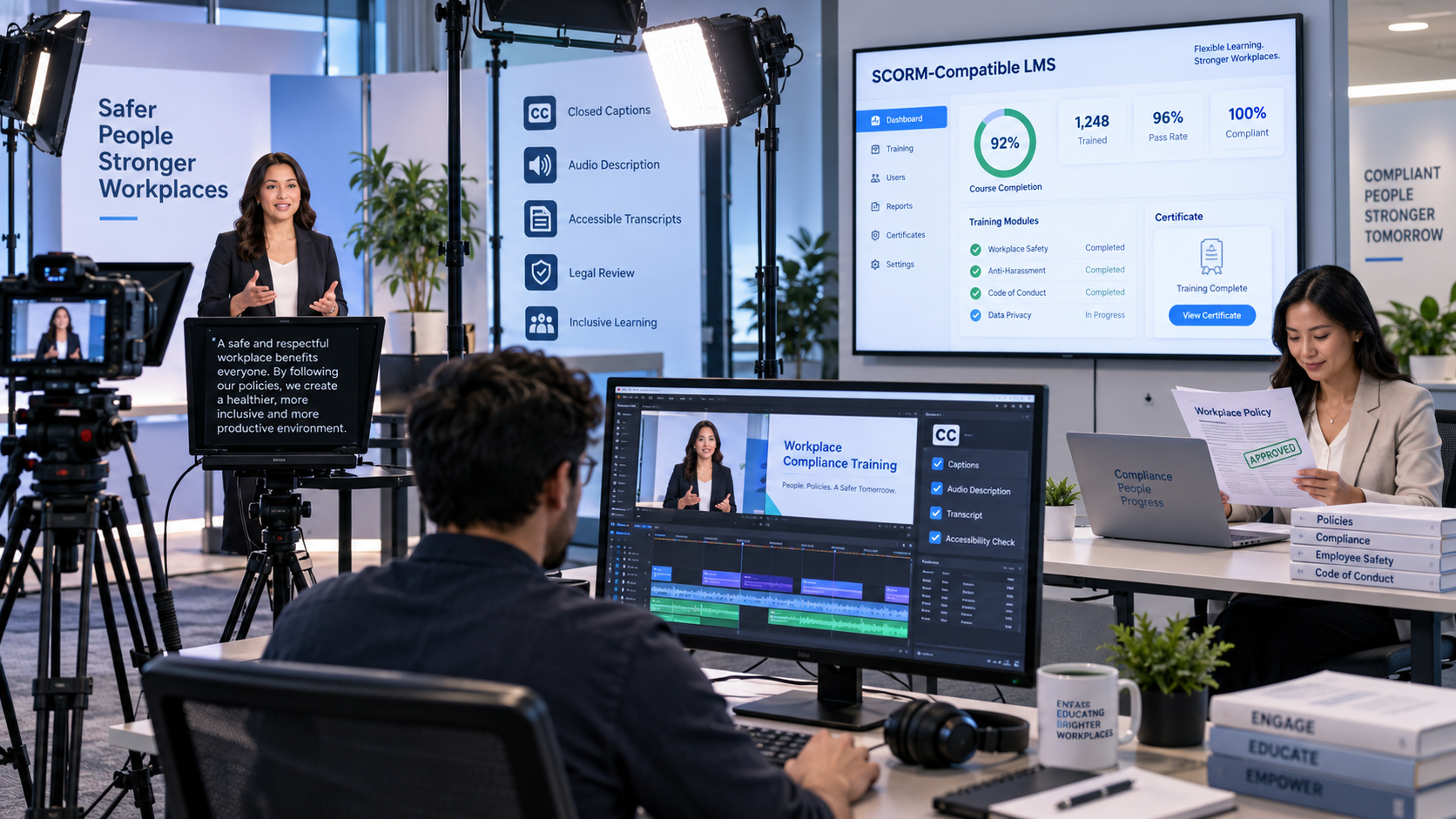
- Captions that are synchronized, accurate, and include speaker identification and relevant non-speech audio. Auto-generated captions do not meet the standard; they need human correction. We produce both closed captions, which the viewer can toggle on and off, and open captions, which are burned into the picture. Open captions matter for social platforms that autoplay muted and for playback environments where the viewer has no caption controls. Both are completed and reviewed before final delivery, not added afterward.
- Audio description for visual information that isn't conveyed in the audio track, such as on-screen text, charts, and demonstrations. This may be a separate described version or built into the narration.
- A transcript delivered alongside the video.
- Player and platform accessibility: keyboard-navigable controls, no autoplay with sound, sufficient contrast on on-screen text.
- ASL interpretation where the audience or the requirement calls for it. We've embedded interpreters directly in the frame as part of the shot design rather than compositing them in as an afterthought, which produces a better result for Deaf viewers and avoids the picture-in-picture box that gets cropped out of every social cut.
The reason this matters at the budget stage: accessibility requirements are far cheaper to plan for in discovery than to retrofit after final approval. Audio description in particular can affect how a video is scripted and paced, not just what gets added at the end.
Learn more about our accessibility and Section 508 capabilities.
Stage 5: Delivery and Distribution
After final approval, the video is exported, QC'd, and prepared for each channel it's going to.
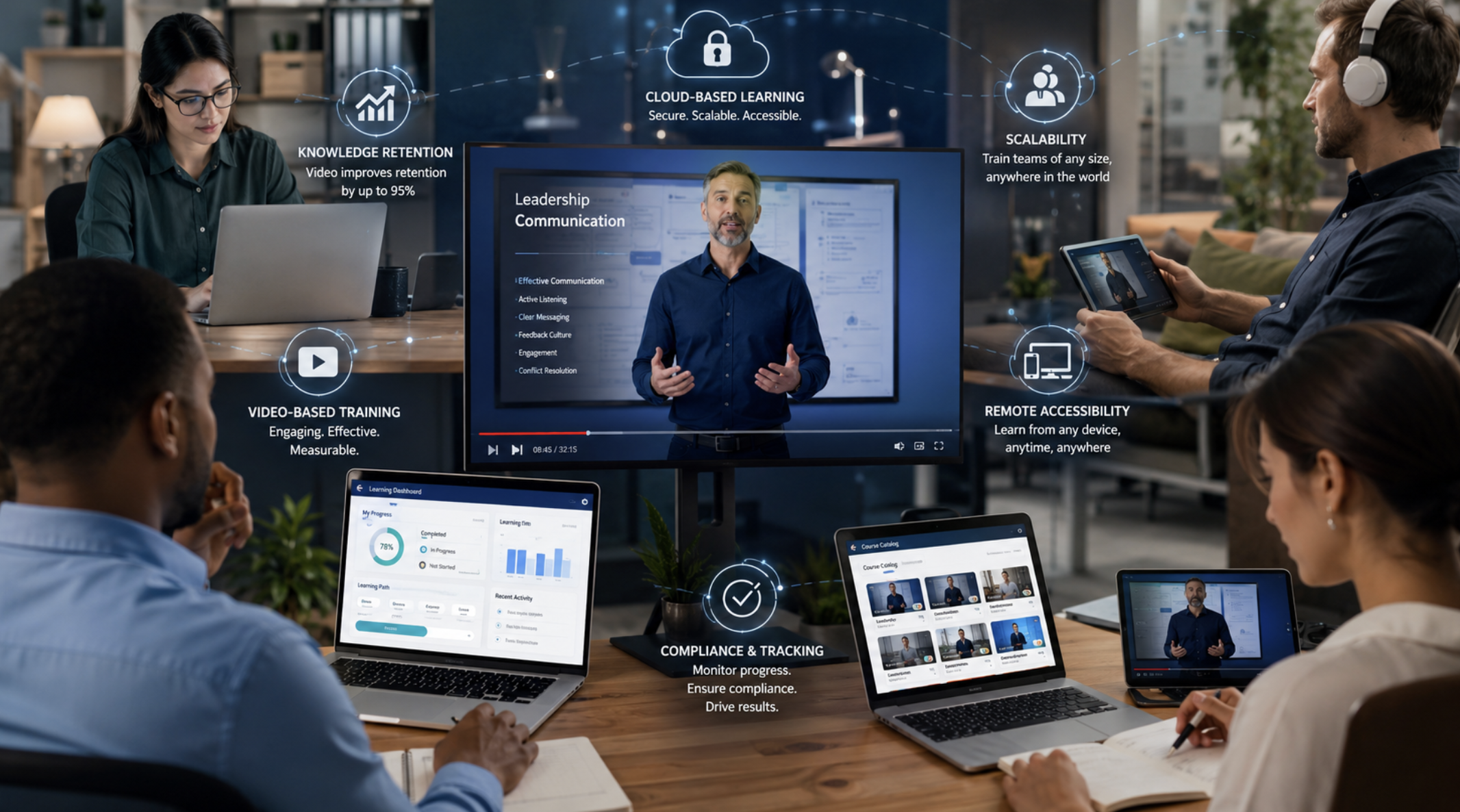
Deliverables commonly include versions for company websites and landing pages, intranets and employee platforms, executive presentations, social media, virtual events and conferences, learning management systems, and broadcast or paid media.
Different platforms want different things: file format, aspect ratio, resolution, bitrate, caption format, thumbnail, duration limits. A single website video often ships alongside a captioned version, a square or vertical social cut, and a presentation-ready file that plays reliably from a laptop in a ballroom.
Before delivery we run a final technical review to confirm the approved edit, audio levels, graphics, captions, and format specs are correct in every version.
You own the work. At the end of every project, all of the raw footage goes to you, and the copyright to both the footage we shoot and the final edited video is yours. Some production companies treat original material as leverage for the next job. We don't. You paid for the production, so you get what came off the cards and the finished piece, which means your team can pull an extra cut a year from now without booking another shoot.
Confirm your usage rights before you distribute. The distinction that matters is between what we shoot and what we license. Footage we shoot for you is yours. Licensed music, stock footage, stock photography, voice talent, and on-camera appearances all carry terms covering where the video can run, for how long, and whether paid media is included. Stock footage in particular is normally licensed for the specific project it was bought for and cannot be moved into a different production unless the license says otherwise. A license that covers organic social does not automatically cover a paid campaign. This should be settled in the scope of work, not discovered after legal asks.
How long it takes: several business days after approval, depending on the number of versions and formats.
How Long Does Corporate Video Production Take?
Four to twelve weeks from discovery to final delivery is the realistic range for most corporate video projects. A single-location interview piece can move faster. Multi-location shoots, animation, and long approval chains take longer.
| Stage | Typical duration |
|---|---|
| Discovery and strategy | Several days to two weeks |
| Scripting and storyboarding | Several days to two weeks |
| Filming | One day to several shoot days |
| Post-production and revisions | One to three weeks |
| Final delivery | Several business days after approval |
The variable that moves the schedule most isn't filming or editing. It's how quickly your stakeholders review. A three-day turnaround on script approval and a three-week turnaround on script approval produce the same video on very different dates.
What Does Corporate Video Production Cost?
Most production companies won't answer this on a website. Here are our actual ranges.
Most of our projects land between $3,750 and $25,000. Where a specific project falls inside that band comes down to three things:
- How many shoot days. The biggest single lever. A second day costs more than almost any decision made in the edit.
- Whether editing is included. Some clients want us to shoot and hand off the footage to their own team. That is a legitimate way to buy production, and it costs less.
- How many final deliverables. A hero video plus four social cuts is five edits, not one.
Read the table with those three in mind and the ranges explain themselves.
| Project type | What's included | Typical range |
|---|---|---|
| Capture only, one location | One shoot day with crew and gear. Raw footage delivered to your team. No edit. | $3,750 to $4,500 |
| Single-location interview or leadership video | One shoot day, plus full post-production: edit, color correction, sound mix, music, titles and graphics, captions, and your revision rounds. One finished, delivered video. | $10,000 to $15,000 |
| Multi-location brand story or company profile | Multiple shoot days across multiple locations. Finished video plus social cuts. | $15,000 to $22,500 |
| Multi-day event coverage | Multiple days on site. Highlight video plus shorter cutdowns. | $15,000 to $25,000 |
These are project fees, not stage-by-stage line items, and every project gets a specific estimate after discovery.
The top two tiers overlap, and that is not a mistake. Complexity drives cost more than location count does. A multi-day event with several final deliverables can run above a straightforward two-location brand story. Use the table to find the neighborhood, not the exact number.
Animation sits outside this table on purpose. It runs $5,000 to $15,000, and it isn't a project size so much as a technique. It can be produced on its own, or added to any of the rows above. The range is wide because cost tracks screen time and complexity rather than project length. A 60-second explainer with simple 2D motion graphics and a three-minute character-animated piece are very different builds.
If you already have an internal editor, tell us in the first conversation. It moves the estimate meaningfully and it changes what we shoot.
Beyond those three main levers, the other things that move a corporate video budget:
- Number of locations, and travel between them.
- Crew size. A two-camera interview setup with a dedicated audio mixer is a different day than a single operator.
- Talent. On-camera actors and professional voiceover carry both a day rate and usage fees.
- Accessibility requirements. Captions, audio description, ASL interpretation, and transcripts.
- Revision rounds beyond what's included in scope.
Two things blow up budgets more often than anything on that list, and neither one is a creative decision.
No rain date. If you're shooting exteriors and the budget doesn't carry a contingency day, weather doesn't negotiate. You either lose the shot or you pay for a return trip that nobody planned for.
An unsecured location. The client approves a location, the crew shows up, and the person actually controlling that space has no idea anyone was coming. In twenty-five years this has happened to me more than a few times. "Approved" and "secured" are not the same thing. Someone needs written confirmation from whoever holds the keys, not a verbal yes from three levels up.
What Goes Wrong in Corporate Video Production?
Five patterns I see repeatedly, all preventable:
- No named approver. Reviewers multiply, feedback conflicts, and the edit cycles.
- Script changes after the shoot. If the question wasn't asked on camera, the answer doesn't exist. Reshoots cost a full day.
- Deliverables decided at the end. Social cuts and vertical versions are cheap to plan for and expensive to bolt on.
- Accessibility treated as post-processing. Audio description in particular affects scripting and pacing.
- Unrealistic launch dates set before scoping. A date tied to a conference is a real constraint. Tell us in the first meeting, not the third.
Frequently Asked Questions
Corporate video production runs through five stages: discovery and strategy, scripting and storyboarding, production, post-production, and delivery. Each stage produces an approval that the next stage depends on, which is why the process is sequential rather than parallel.
Most of our projects fall between $3,750 and $25,000. Capture-only work, where we shoot and hand the raw footage to your team, runs $3,750 to $4,500. A single-location interview or leadership video, filmed and fully edited, runs $10,000 to $15,000. A multi-location brand story runs $15,000 to $22,500, and multi-day event coverage runs $15,000 to $25,000. Animation runs $5,000 to $15,000 and can be standalone or added to any of these. Shoot days, whether editing is included, and the number of final deliverables are what move a project within its range.
Run time matters less than most people expect. A two-minute single-location interview video, filmed and fully edited, falls in our $10,000 to $15,000 range. The same two minutes built from multi-location filming, or delivered with social cutdowns and a captioned version, moves into the tier above. What drives cost is shoot days, deliverables, and complexity, not duration.
Every project includes three full rounds of revisions, plus up to two additional rounds of minor changes. Most projects finish inside the fixed cost set at the start. If a project is heading past the included rounds, we tell you before the work happens rather than on the final invoice.
Four to twelve weeks from discovery to final delivery for most projects. A single-location interview video can be faster; multi-location shoots, animation, and long approval chains take longer. Stakeholder review speed affects the schedule as much as production does.
Because filming is the one stage that can't be redone cheaply. Decisions made in discovery and scripting determine what gets captured, and anything not captured on the shoot day either requires a reshoot or doesn't make it into the video.
Most projects include one approval at script or storyboard, and one to two review rounds in post-production. Organizations with legal, compliance, or accessibility review add stages.
Both. On-location filming gives authentic workplace context. A studio gives control over lighting, sound, and background, and removes the scheduling risk of a live facility. Many projects use both.
It's exported in the required formats for each channel, QC'd, and delivered with any captioned versions, alternate cuts, and transcripts in scope. Usage rights for music, footage, and talent should be confirmed before distribution.
You do, on both counts. Clients receive all of the raw footage at the end of the project, and the client holds the copyright to the footage we shoot and to the final edited video. It isn't an upsell and it isn't held back. You paid for the production, so the work is yours, which also means your team can pull additional cuts later without booking another shoot.
One important exception: licensed material. Any footage we purchase from a stock library is licensed for that specific project, and normally cannot be reused in other productions unless the license terms clearly allow it. The same principle applies to licensed music, stock photography, and talent appearances. Owning the finished video does not by itself extend those third-party licenses to a new use. If you're planning to repurpose material later, tell us during discovery so we can license accordingly from the start rather than going back to renegotiate.
Yes, and in detail. A significant portion of our work is disability-focused, which means 508 isn't a checkbox we clear at the end of a project. It's built into how we scope, script, and shoot. We produce audio description, both open and closed captioning, and we've embedded ASL interpreters directly in frame rather than treating interpretation as a separate deliverable. If your project has a compliance requirement, bring it to the first conversation and we'll build the production around it.
Which Service Is Right for You?
The right service depends on your audience, your message, and where the finished video will live.
- Corporate Video Production for leadership communications, training, brand stories, recruitment
- Association Video Production for member communications, conferences, education, advocacy
- Nonprofit Video Production for outreach, public education, fundraising, mission storytelling
Let's Talk About Your Project
Give us fifteen minutes. We'll ask about your audience, your message, your timeline, and what you're actually trying to get done.
If we're the right fit for the project, we'll tell you. If we aren't, you'll still walk away with a few production considerations you hadn't thought about: the questions to ask, the things to nail down before anyone quotes you, and the places projects tend to go sideways. That's worth the fifteen minutes either way.
We're based in Bethesda, Maryland, we work throughout Washington, D.C., Maryland, and Virginia, and we travel nationally for clients who need us on site.
Happy to jump on a call anytime.
Schedule a call · patrick@raffertyweiss.com · 301.922.5405
About the author
Patrick Rafferty is Owner and Executive Producer of RaffertyWeiss Media, a video and eLearning production company he has run since 2001 from Bethesda, Maryland. RaffertyWeiss Media holds GSA Schedule #47QRAA20D0017 and has produced work for federal agencies, associations, nonprofits, and corporations, with Telly, Communicator, Davey, and CINE Golden Eagle awards along the way.
.webp)